
Lady Spring Wood Project Report
26 March 2020
Martin Brampton
Introduction
To recap, this MNAP project started in around 2016, prompted by the former boardwalk and the bridge over the Cut having passed their end of useful life. Grants from Yorventure, Ryedale District Council S106 funds, North Yorkshire County Council Locality Budget combined with crowdfunding to provide replacements. Local people helped with the project, notably Fiona Croft, Sarah Oswald, and Alan Mitchell of Maltech. Volunteers were recorded working on the boardwalk.
Here I am attempting to lay out the current position and some future considerations. Having come to the project only recently, I apologise for any mistakes and welcome corrections or additions.
The Bridge over the Cut
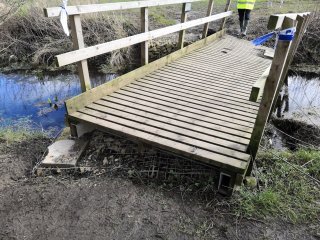
Again to recap, the bridge has been constructed by installing gabions (wire mesh containers filled with stones) into the banks. The bridge is wooden boards with hand rails, and is supported by steel girders and cross braces. It rests on paving stones on top of the gabions.
The engineering design was kindly provided by Alan Mitchell of Maltech on a pro bono basis and the bridge was installed by The Conservation Volunteers (TCV).
For much of the time, water in the Cut is still or moving very slowly. But when the River Derwent floods, it can rise to a level where the bridge is submerged. In this situation, the full flow of the river extends over the flooded region. This happened last winter, and the bridge was swept out of position.
Bridge Investigations and current situation
- Inspect the bank below the gabions to see whether there has been scouring that could lead to instability
- Review the quality of the stones used to fill the gabions, which are thought to lack the ideal level of weather resistance
Outline Bridge Proposals
- Alan is currently talking to the Drainage Board, who have responsibility for maintenance of the Cut, to see whether they could put the bridge back in place soon.
- Later in the year, a contractor is needed with equipment that is capable of moving the bridge
- The effects of flooding can be somewhat mitigated by raising the bridge. This can be done by adding a “cushion” similar to the gabions, being a wire mesh container filled with stone. It can be 300, 450 or 600 mm deep.
- The toe boards can be removed and replaced by a permeable barrier such as wire mesh
- Anchors are needed that can be fixed into the bed of the Cut or the banks, and linked to the bridge to prevent it being swept away
- The path can be made to smoothly join the bridge by adding stone, which may need some kind of retaining barriers
Sign Posts
Culvert Over the Cut
The Cut goes through a culvert adjacent to Tate-Smith premises. The footpath that joins Sheepsfoot Lane to the boardwalk goes over the stonework of the culvert. The stonework is in need of repair, at a cost of £1,412.00 (plus VAT). This estimate was received some time ago, and may need to be updated.
It is also intended that a railing should be installed here, the intention being to commission TCV. The cost estimate from TCV was £1,200 plus VAT, although this is now expired. Part of the work has been done, and the cost for the remaining work is expected to be £600. It may be necessary to extend the railing, so as to provide a barrier to the drop at either side of the stonework. That may incur a modest extra cost for additional materials.
When the first part of the work was done, the path on one side was cleared and levelled. That may also be done on the other side when the second stage is completed.
There is a question over whether the path over the culvert needs to be widened – see the accessibility section below.
Accessibility
The project originally intended to deliver accessible walks, usable by wheelchairs or other mobility supports. The boardwalk itself has been designed accordingly, being comfortably wide enough, and having occasional passing places. Accessibility was publicised as an aspect of the project.
However, the paths at either end of the boardwalk are impassable by wheelchairs in places. Just how much improvement is feasible would need to be evaluated.
In my view, it is highly desirable that this aspect of the project should be completed, although I recognise that this is a sizeable project in its own right. Raising the standard of the footpaths so as to be usable by wheelchairs etc in all but the worst weather would require significant work and corresponding expenditure. It is probably a reasonable assumption that a determined effort to locate funding support would ultimately be successful. There could be costs to achieving funding. Support from local sources would be very valuable in helping to attract funding, and there is also the possibility of another crowdfunder for this aspect of the project.
Current Financial Position
The project’s finances are tight. Money from grants is held by Malton Town Council on behalf of MNAP and currently amounts to £6,663.00. Against this, we have the following items for which funds are earmarked:
Sign posts £3,639.91
Culvert repairs £1,412.00
Railings £600.00
leaving a net balance of £1,011.09. There will be some cost to restoring the bridge, as yet unknown. Hence there will not be a lot left, and certainly not enough to deal with footpath accessibility.
In addition, the MNAP bank balance is currently £2,346.06 but a rent demand for £1,000 is expected within weeks. On the credit side, the last payment of a 3 year sponsorship of £250 per year is expected in July.
Long Term Finances
We need to consider the long term situation. With the sole sponsorship agreement about to expire, MNAP has no assured continuing income. In theory it is possible to look for further sponsorship. In practice, this route does not seem very promising as a way of securing an income sufficient to pay for the annual rent and for maintenance costs as they arise. Grants are available for capital projects, but rarely for running costs.
The Fitzwilliam Estate undertakes a periodic tree survey at its own expense, but remedial work can be costly. Invasive Himalayan Balsam is present and needs to be kept down. In the past TCV has been paid to do this, but it may be possible to have the work done by local volunteers if the requirement is explained to them. The mosaics need occasional cleaning with clean water, again something where we might hope to have volunteer support.
The way forward looks to be negotiations with all the local interested parties. A great deal of work has been done by many volunteers and a large amount of money expended on a valuable project. It would be inconceivable to allow it to fail at this stage.